
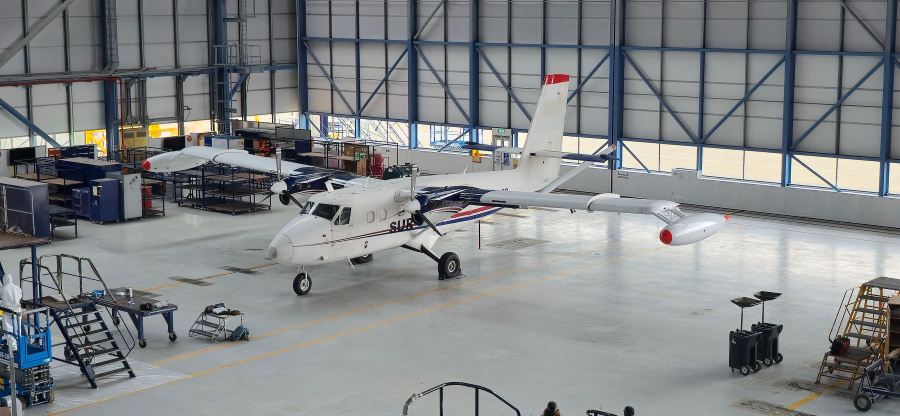
Aircraft Specifications
| Specification | Value |
|---|---|
| Role | EM & Multi-Sensor Platform |
| Fleet Quantity | 2 |
| Registration | C-GSGF / C-GSGP |
| Cruise Speed | 315 km/h |
| Endurance | 8+ hours |
| Gross Weight | 5,670 kg |
Equipment
- Frequency Domain Electromagnetics
- Magnetics
- AIRGrav
- Radiometrics
- Methane Mapping
- Others
| Registration | C-GSGF | C-GSGP |
| Serial # | 642 | 289 |
The de Havilland DHC-6 Twin Otter is an all metal, high wing, twin-engine, short takeoff and landing (STOL) aircraft. The Twin Otter is powered by two Pratt & Whitney Canada PT6A-27 engines. These engines drive a constant speed, fully feathering, reversible propeller. The PT6 turbine engines provide ample power for climbing over steep terrain, working at altitudes up to 7,000 m and can withstand frequent rapid power changes. The aircraft is highly maneuverable, rugged in design and can be flown at speeds from 80 to 160 knots. The low stall speeds and abundant available power make the Twin Otter a safe and effective aircraft for surveys requiring drape flying over rough topography, low air speeds or flights at high altitude. The aircraft has fixed gear, extendable flaps and manually adjustable trim tabs on the primary controls for the roll and pitch axes and full rudder trim for the yaw axis. The aircraft is equipped with full deicing equipment and sufficient avionics for instrument flying including a flight control system. Supplementary fuel can be added for transoceanic flight. The Twin Otter is certified for IFR flights in known icing conditions.
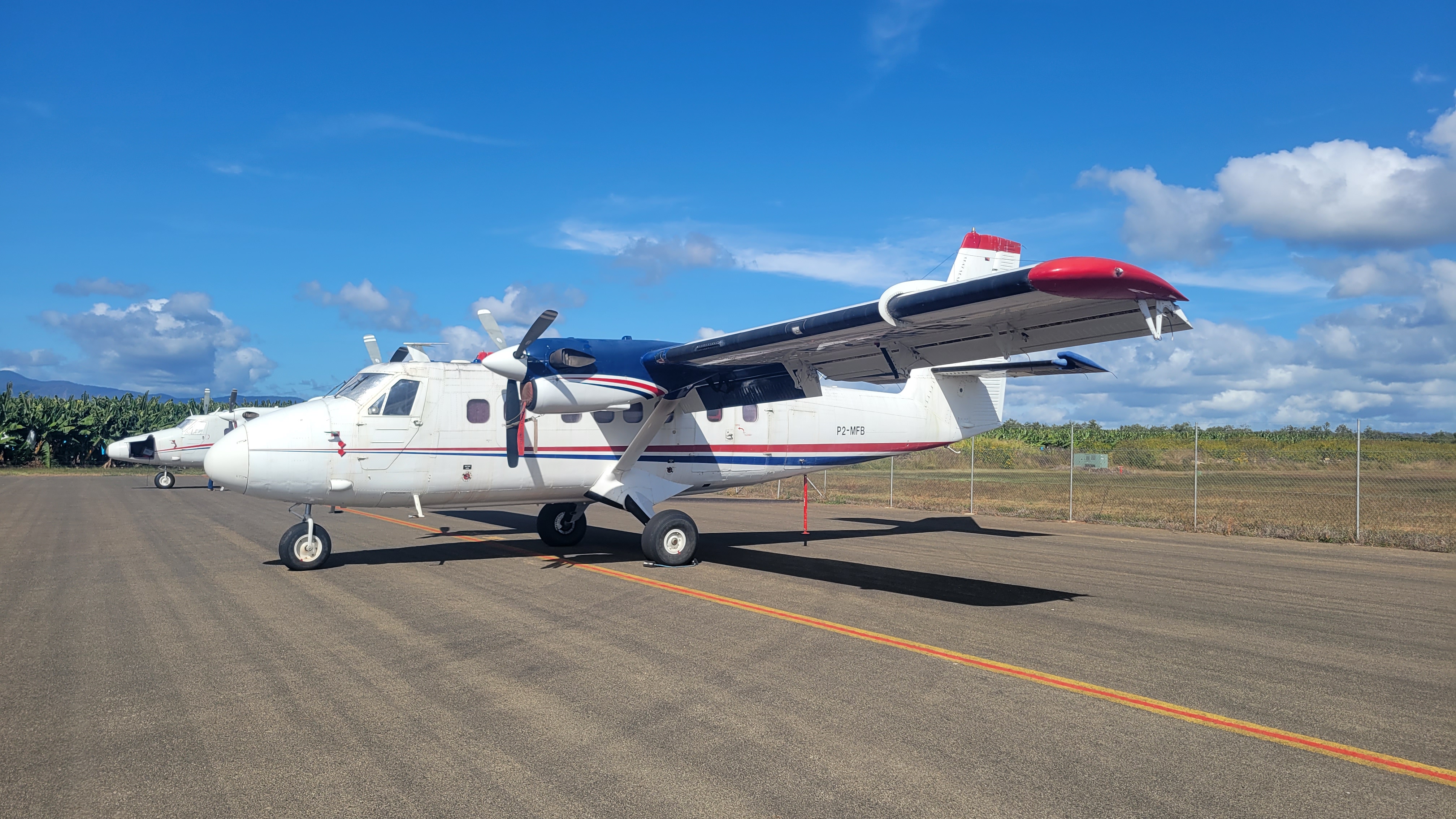
Geophysical Surveying
The SGL Twin Otter is fully equipped for airborne magnetic, gravity, radiometric and frequency-domain EM surveys. EM fields are measured with the SGL frequency-domain EM system (SGFEM). The four-frequency EM transmitter is located in the right wingtip EM pod, and the receiver is located in the left wingtip EM pod. The magnetic field is measured by one sensor mounted in a stinger that is rigidly attached to the tail of the aircraft, and a second sensor can be mounted in the left wingtip EM pod. Gravity surveys are performed using SGL's state-of-the-art AIRGrav system. The Twin Otter can carry up to 63 litres of detector crystals for gamma-ray spectrometer surveys.
de Havilland DHC-6 Twin Otter Specifications
Crew Capacity:
- 2 pilots,
- 1 operator (optional)
Fuselage:
- semi-monocoque
Wings:
- strut braced, high wing
- outboard ailerons and trim tab, full span flaps
Tail:
- conventional stabilizers
- elevator and rudder with trim tabs
Power Plant:
- Pratt & Whitney Canada PT6A-27, 680 shp, free-turbine gas engine, overhaul 3,600 hours
- three-blade, fully-feathering, constant-speed, reversible propeller, overhaul 3,000 hours or 5 years
Systems:
- dual flight controls with IFR instruments and avionics
- 2-axis autopilot
- full airframe and propeller de-icing
Dimensions:
| Wing span | 65 ft | 19.8 m |
| Exterior length | 51 ft 9 in | 15.8 m |
| Exterior height | 19 ft 6 in | 5.94 m |
| Interior usable length | 18 ft 5 in | 5.61 m |
| Interior usable width | 4 ft 4 in | 1.32 m |
| Interior height | 4 ft 11 in | 1.5 m |
| Usable fuel capacity | 385 US gal | 1,455 L |
Weights:
| Empty | 8,100 lb | 3,674 kg |
| Maximum take-off | 12,500 lb | 5,670 kg |
Performance:
(2,000 ft ASL, standard day, maximum take-off weight, 1,900 rpm, 1,375 ft-lb tq)
| Range, maximum range power (plus reserve) | 920 nm | 1,704 km |
| Cruise speed at maximum range power | 170 kt | 315 km/h |
| Fuel flow at maximum range power | 73 US gal/h | 275 l/h |
| Stall airspeed, landing configuration | 58 kt | 107 km/h |
| Service ceiling | 25,000 ft | 7,620 m |
| Minimum required runway length | 2,500 ft | 762 m |
| Rate of climb | 1,600 ft/min | 488 m/min |
| Maximum sustained climb gradient | 650 ft/nm | 107 m/km |
Type of Aviation Fuel: Jet A, A-1, B, JP-1, 4, 5, 8
Maximum Endurance: 8 hours plus 1 hour reserve at maximum range power
Geophysical Capabilities
SGFEM, frequency-domain EM
AIRGrav, SGL airborne gravimeter
Magnetic total field
Horizontal magnetic gradient
Gamma-ray spectrometer, up to 63 litres (3,840 in3) of detector crystals
SGMethane, methane gas sensing
Additional Features
- Tail stinger 6.8 m long and 22 cm in diameter, capable of housing a 1 kg sensor
- HF radio
- Video camera mount with 23 cm diameter glass covered opening in the belly of the aircraft
- Two instrument racks, standard 48 cm (19 in) width
- Radar altimeter, 0-750 m
- Electrical power capacity, 28 VDC at 200 amp
- Static inverters, 115 VAC - 400 Hz, 110 VAC - 60 Hz
- GNSS receiver and antenna