
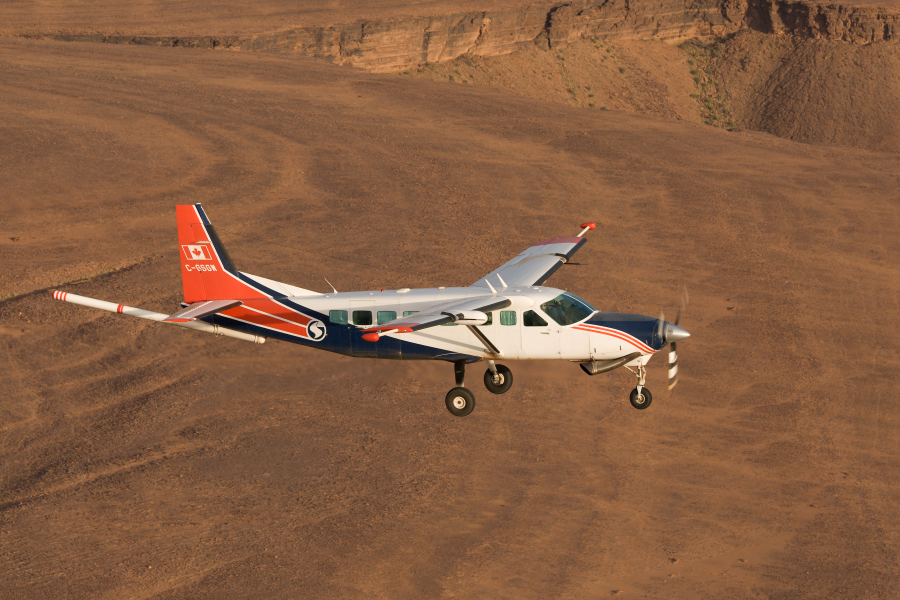
Aircraft Specifications
| Specification | Value |
|---|---|
| Role | Primary Survey Platform |
| Fleet Quantity | 8 |
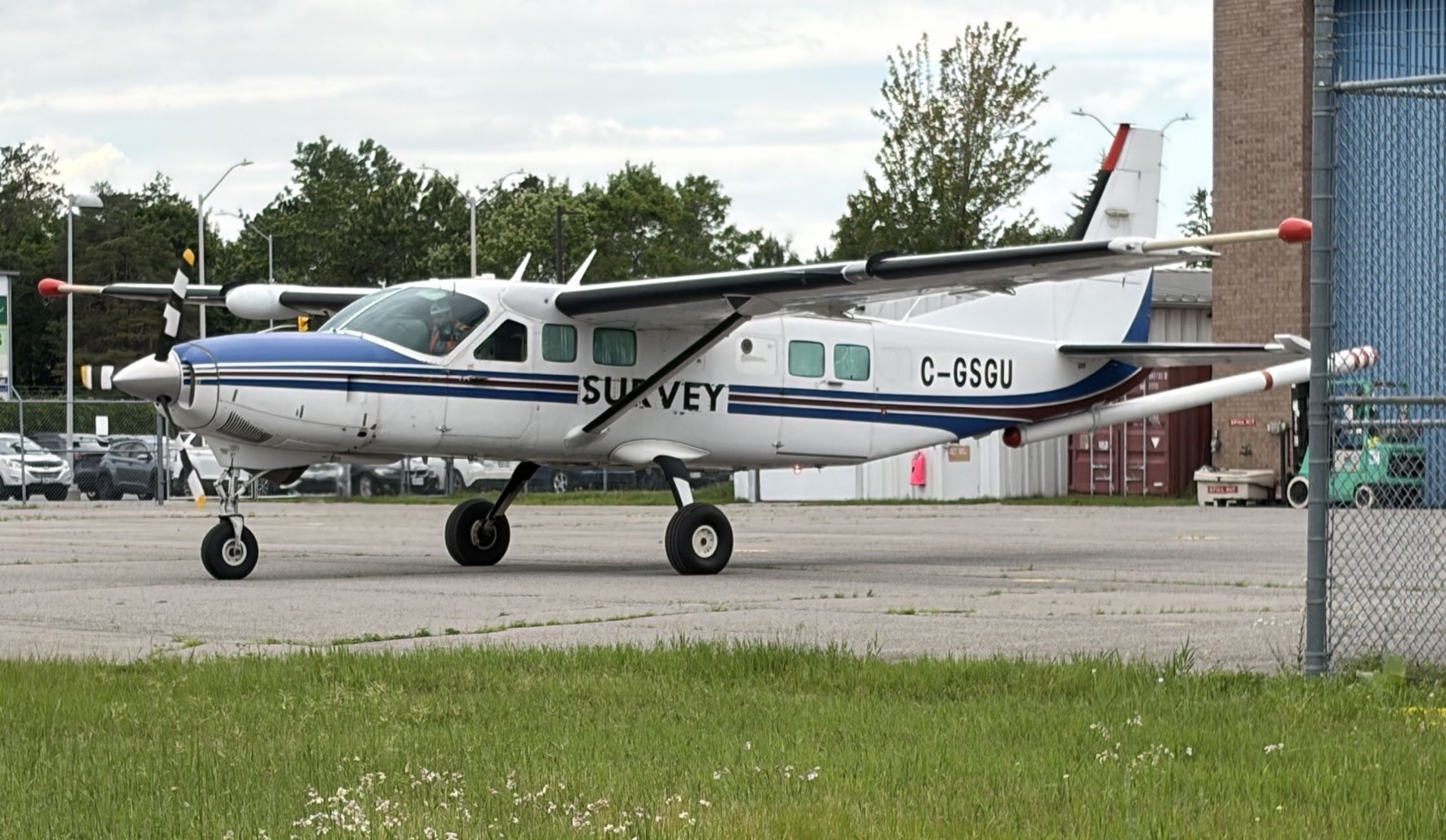
| Registration | C-GSGA / C-GSGJ / C-GSGL / C-GSGU / C-GSGV /C-GSGW / C-GSGY / C-GSGZ |
| Cruise Speed | 287 km/h |
| Endurance | 8+ hours |
| Gross Weight | 4,110 kg |
Equipment
- Magnetics
- AIRGrav
- Radiometrics
- LiDAR
- Methane Mapping
- Others
| Registration | Serial # |
|---|---|
| C-GSGW | 208B0646 |
| C-GSGY | 208B0600 |
| C-GSGZ | 208B0493 |
| C-GSGL | 208B0783 |
| C-GSGV | 208B0524 |
| C-GSGU | 208B0747 |
| C-GSGJ | 208B1187 |
| C-GSGA | 208B1228 |
The Cessna 208B Grand Caravan is an all metal, high wing, single-engine aircraft powered by a Pratt & Whitney Canada PT6A-114A engine. This engine drives a constant speed, fully feathering, reversible propeller. The aircraft has fixed gear, extendable flaps and manually adjustable trim tabs on the primary controls for the roll and pitch axis and full rudder trim for the yaw axes. The aircraft is equipped with full de-icing equipment and sufficient avionics for instrument flying including a flight control system and weather radar. Supplementary fuel can be added for transoceanic flight. The Caravan is certified for IFR flights in known icing conditions.
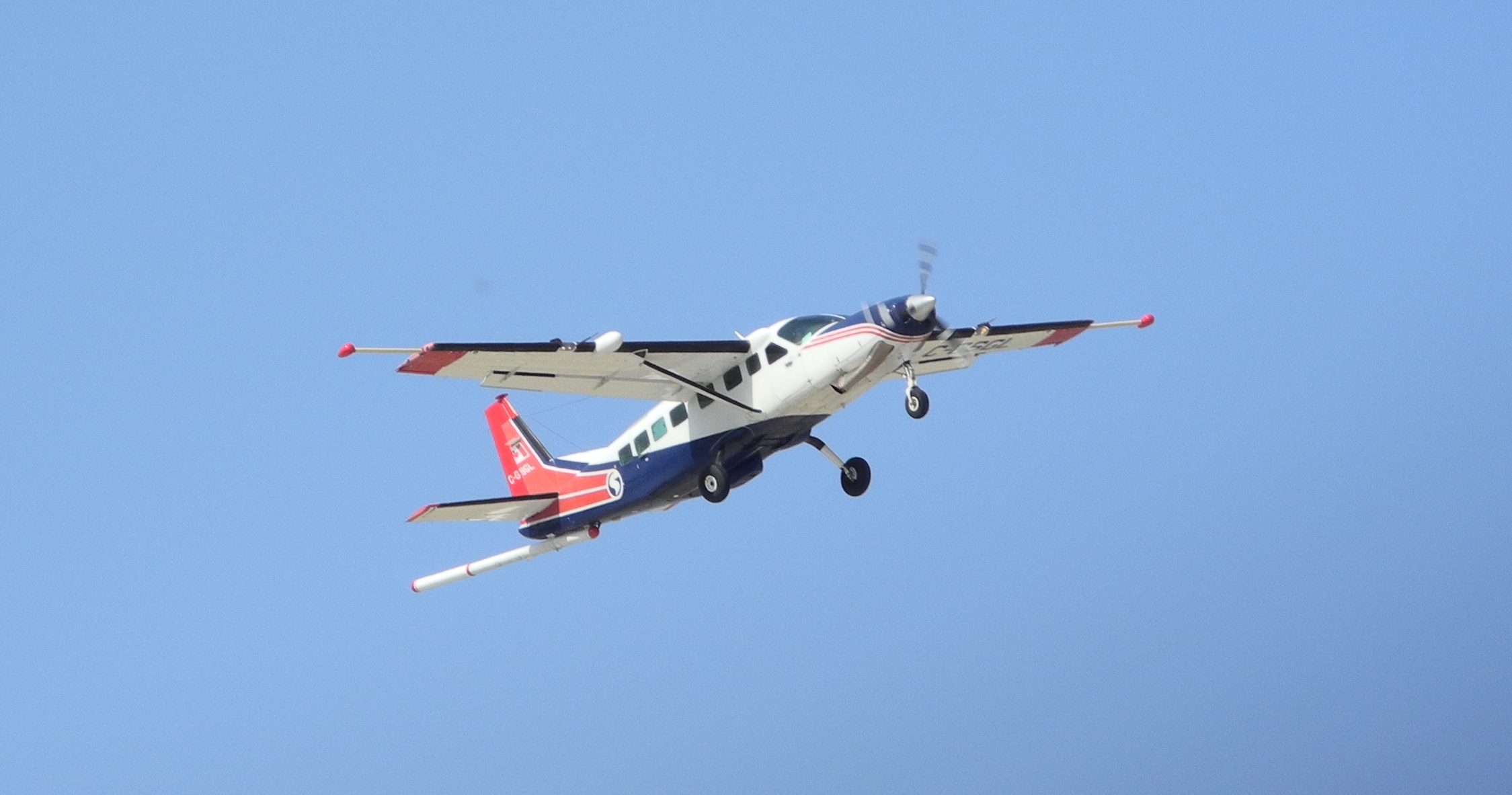
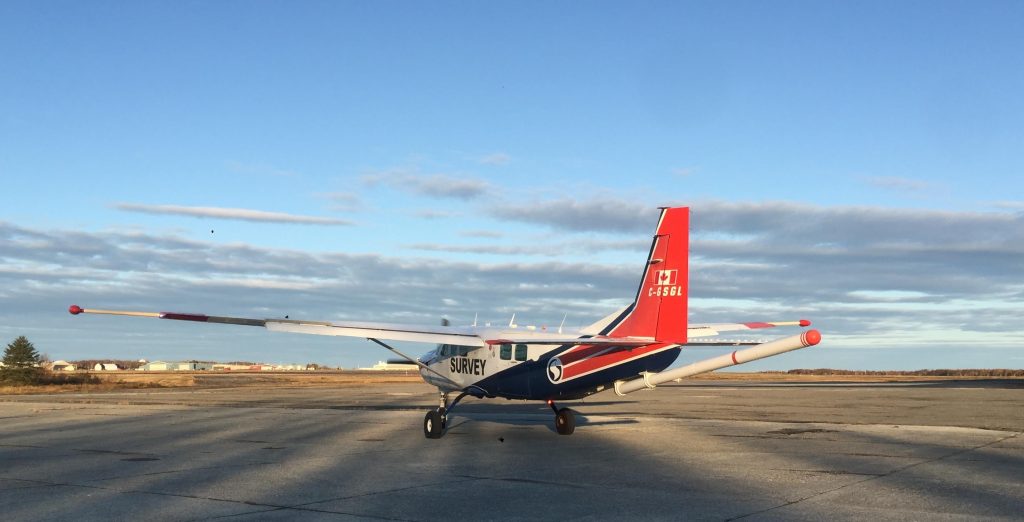
SGL aircraft have a rigid aluminum and composite material 3 m tail stinger designed to accommodate the magnetometer sensor. The stinger can be easily removed and the aircraft returned to its original configuration. There is a camera hole in the belly of the aircraft and provisions for other survey and navigation systems.
Geophysical Surveying
The Cessna Grand Caravan uses the extremely reliable Pratt & Whitney Canada PT6 turbine engine. These engines have recorded tens of millions of hours of flight time and with virtually no in-flight engine stoppages due to mechanical failure. Over 2,000 Caravans are in use around the world. Because the Caravan has one engine, fixed landing gear, and no single engine control speed limitations, it is considered an easy and very safe aircraft to fly. The PT6 turbine engine provides ample power for climbing over terrain, working at altitudes up to 7,000 m and can withstand frequent rapid power changes. The low stall speeds and abundant available power, mean that the Caravan is a safe and effective aircraft for surveys which require low airspeed, drape flying over rough topography, or flights at high altitude.
Cessna 208B Grand Caravan Specifications
Crew Capacity:
- 2 pilots,
- 1 operator (optional)
Fuselage:
- semi-monocoque
Wings:
- strut braced, high wing
- outboard ailerons and trim tab
Tail:
- conventional stabilizers
- elevator and rudder with trim tabs
Power Plant:
- Pratt & Whitney Canada PT6A-114A, 675 shp, free-turbine gas engine, overhaul 3,500 hours
- three-blade, fully-feathering, constant-speed, reversible propeller, overhaul 3,500 hours
Systems:
- dual flight controls with IFR instruments and avionics
- flight control system
- 2-axis autopilot
- weather radar
- full airframe and propeller deicing
Dimensions:
| Aircraft Component | Size (imperial) | Size (metric) |
|---|---|---|
| Wing span | 52 ft 1 in | 16.11 m |
| Exterior length | 41 ft 7 in | 12.68 m |
| Exterior height | 15 ft 5.5 in | 4.72 m |
| Interior usable length | 15 ft 10 in | 4.83 m |
| Interior usable width | 5 ft 4 in | 1.63 m |
| Interior height | 4 ft 6 in | 1.37 m |
| Usable fuel capacity (with survey tank) | 519 US gal | 2,011 L |
Weights:
| Aircraft | Weight (lb) | Weight (kg) |
|---|---|---|
| Empty | 4,237 | 1,926 |
| Maximum take-off | 9,062 | 4,110 |
Performance:
Standard day, 2000 ft ASL, maximum take-off weight, 1,900 rpm, 1,375 ft-lb tq.
| With these Conditions | Imperial | Metric |
|---|---|---|
| Range, maximum range power (plus reserve) | 1,450 nm | 2,685 km |
| Cruise speed at maximum range power | 155 kt | 287 km/h |
| Fuel flow at maximum range power | 50 US gal/h | 189 L/h |
| Stall airspeed, landing configuration | 61 kt | 113 km/h |
| Service ceiling | 25,000 ft | 7,620 m |
| Minimum required runway length | 2,500 ft | 765 m |
| Rate of climb | 975 ft/min | 297 m/min |
| Maximum sustained climb gradient | 650 ft/nm | 107 m/km |
Type of Aviation Fuel: Jet A, A-1, B, JP-1, 4, 5, 8
Maximum Endurance: 8 hours plus 1 hour reserve at maximum range power
Geophysical Capabilities
AIRGrav, SGL airborne gravimeter
Magnetic total field
Triaxial magnetic gradient
Gamma-ray spectrometer, up to 63 litres (3,840 in3) of detector crystals
SGMethane, methane gas sensing
Additional Features
- Tail stinger, 3 m long, 21 cm in diameter, capable of housing a 5.5 kg sensor
- HF radio
- Video camera mount with 14 cm diameter glass covered opening in the belly of the aircraft
- Two instrument racks, standard 48 cm (19 in) width
- Radar altimeter, 0-3,000 m
- Electrical power capacity, 28 VDC at 200 amp
- Static inverters, 115 VAC - 400 Hz, 110 VAC - 60 Hz
- GNSS receiver and antenna plus data link for real-time corrections
- Cabin fuel tank certified for a normal production flying